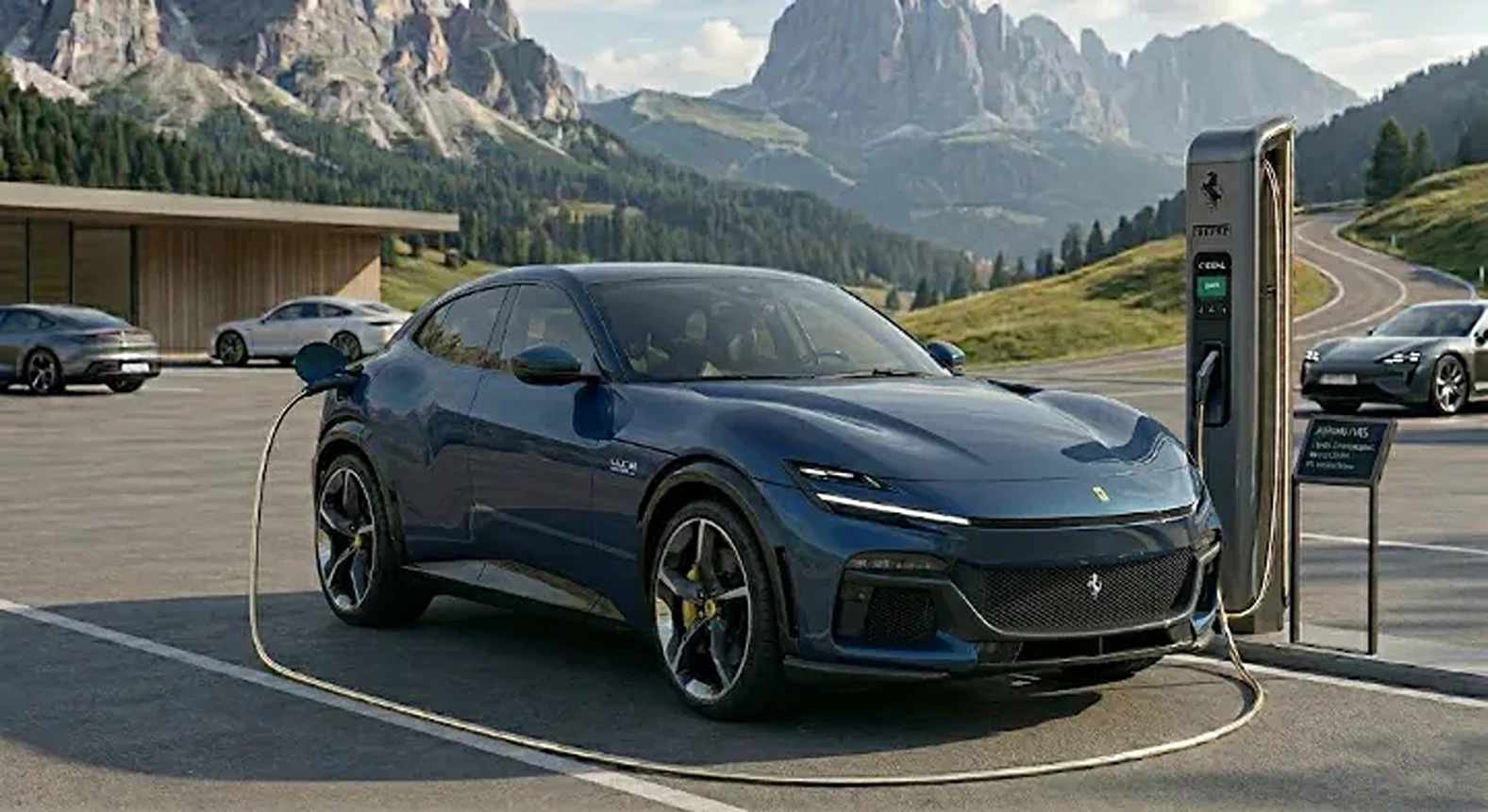
Ferrari Luce Set for Rome World Premiere as Maranello Prices First-Ever Electric Car Above €550,000
Ferrari is weeks away from one of the most consequential moments in its 78-year history. The full exterior reveal of the Luce, the Italian marque’s first fully electric car, is confirmed for May 25, 2026, in Rome, completing a staged three-phase launch that has built anticipation across the automotive world since the powertrain details were first disclosed at Ferrari’s Capital Markets Day in October 2025.
Bloomberg reported last month, citing people familiar with the matter, that Ferrari has settled on a preliminary starting price of approximately €550,000, equivalent to around $647,000. That figure, if confirmed at the Rome event, would establish the Luce as one of the most expensive production electric vehicles ever offered to the public, and it would place it in a bracket that very few rivals can reach. Ferrari has not officially confirmed the pricing, but the ballpark figure is consistent with the brand’s strategy of preserving exclusivity and maintaining the premium over its own combustion models.
The technical specification that has been confirmed is extraordinary by any measure. The Luce produces a combined output exceeding 1,000 horsepower from four permanent-magnet synchronous motors, one at each wheel, arranged using a Halbach array configuration borrowed from Ferrari’s Formula One powertrain programme. The rear axle contributes around 831 horsepower; the front pair adds 281 horsepower. During motorway cruising, the front motors physically disconnect from the drivetrain to reduce drag and extend range, a feature that echoes the driving philosophy of Ferrari’s rear-axle-biased combustion cars rather than simply optimising for efficiency metrics in isolation.
The battery is a 122 kWh unit developed in-house, with cells supplied by SK On, built on an 880-volt architecture that supports 350 kW DC fast charging, among the fastest charging rates of any production road car available today. Ferrari’s stated range target is approximately 330 miles under WLTP testing conditions. The car sits on a bespoke platform assembled in a dedicated facility called the E-Building at Maranello, specifically constructed to produce the Luce at strictly controlled volumes.
What has already been seen publicly is the interior, revealed in February at an event held at San Francisco’s Transamerica Pyramid. Ferrari commissioned LoveFrom, the design studio co-founded by former Apple design chief Sir Jony Ive and Marc Newson, to take creative responsibility for the entire car, working alongside Ferrari’s internal Style Centre under Flavio Manzoni. The result, at least inside the cabin, is a deliberate rejection of the touchscreen maximalism that has come to define most electric car interiors. Physical controls, machined aluminium surfaces and a three-spoke steering wheel referencing Ferrari’s 1950s and 1960s Nardi-inspired designs dominate the space. A 10-inch screen mounted centrally can swivel on its vertical axis to face either driver or passenger.
Ferrari CEO Benedetto Vigna has been careful to frame the Luce as an addition to the lineup rather than a signal of broader electrification strategy. “This is an addition to the lineup, not a transition,” he has said, reiterating that Ferrari’s 2030 product mix targets 20 percent electric vehicles, 40 percent hybrids and 40 percent internal combustion. Annual production across all models is expected to breach 14,000 units for the first time in 2026, a number that would have seemed ambitious even a decade ago.
The full exterior design has been kept closely guarded throughout the development process, with prototypes spotted only under heavy camouflage or disguised with Maserati Levante bodywork during testing. Speculation has centred on a four-door, four-seat grand tourer profile with aesthetic cues drawn from the Purosangue. Italian customer deliveries are scheduled for late 2026, with UK allocations from early 2027. Allocations across all markets are expected to be extremely limited, following Ferrari’s customary approach of prioritising long-standing customers and those with significant purchase histories with the brand.
Whether the exterior design lives up to the technical and design ambition that the interior suggested remains the central question heading into May 25. For a car carrying this much strategic weight, the Rome reveal will be watched very carefully.